Morning-after pill
Nieuwe burenThe Morning-after pill is the object through which a private disagreement about contraception becomes a direct conflict over pregnancy and bodily autonomy. Steef brings it to Eva after a condom accident, presenting it as a practical way to prevent pregnancy; Eva tells him she will take it, then discards it unseen. The pills thus mark a consequential divide: Steef wants to prevent a child from resulting from the encounter, while Eva wants to preserve the possibility that she may become a mother.
Fertility and the Pill's Context
The pill enters a story already shaped by years of frustrated attempts to conceive. When Eva and Peter first sought medical advice after a year of trying, their doctor initially reassured them that there was no reason for concern and recommended temperature tracking. Eva recorded her basal temperature each morning; a rise of 0.2 degrees indicated that ovulation was likely approaching, and sex became timed around that window. The practical routine narrowed intimacy into an obligation scheduled around conception.
After another six months, the strain had become an open marital dispute. Peter wanted a child, but objected to entering medical treatment and longed for their sexual relationship to return to what it had been before conception became its organizing purpose. Eva, whose desire for a child had become consuming, argued that testing might reveal a simple, treatable problem. They subsequently consulted a gynecologist. Eva's examination and ultrasound showed no apparent abnormalities, while two semen tests found that Peter had too few sperm and that those present moved poorly. The couple were told that medical intervention was their remaining route to having a child together.
That history makes the Morning-after pill more than an ordinary precaution. For Eva, the chance of pregnancy is precious precisely because conception has been difficult and medical treatment has made reproduction feel increasingly procedural. The pill is not offered as part of their fertility treatment; it arises after a separate encounter. Yet its purpose—to close off a possible pregnancy—collides with the longing and uncertainty that have already shaped Eva's life.
The Condom Accident and Steef's Offer
The lead-up to the encounter is itself bound up with reproductive intention. Eva and Rebecca discuss swinging and calculate its timing around Eva's expected ovulation. Rebecca proposes what she calls soft coercion and raises the possibility that a condom could leak. This plan places the prospect of pregnancy inside an encounter that is also framed as partner-swapping, without the other participants' agreement to that reproductive aim.
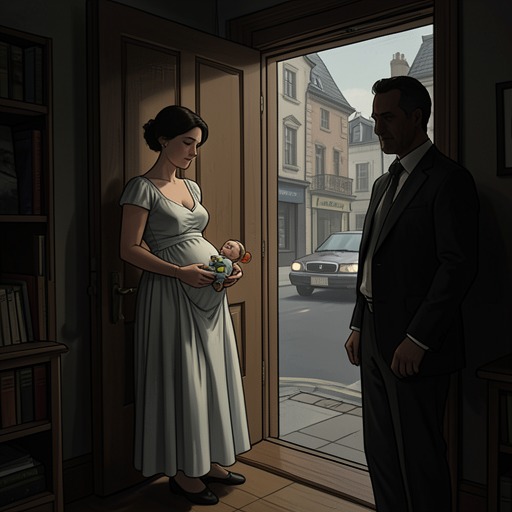
The next morning, Steef comes to see Eva while Peter is absent. Their usual greeting—a kiss—does not happen. Steef apologizes for his response to the condom accident and explains that the pharmacist had described it as such. He has brought a white box from the night pharmacy. The object is physically small and easily passed across a kitchen counter, but its arrival forces the question that the encounter has left behind: whether Eva will take action to prevent a possible pregnancy.
Steef explains that the pack contains two pills, one to be taken immediately and the other twelve hours later. He warns that Eva may feel nauseous, though she may not, and says the pills make it 95 percent certain that she will not remain pregnant. Eva asks about the likelihood rather than accepting the box without question. The figure gives the decision a starkly practical appearance, but it does not settle what either of them wants the possible pregnancy to mean.
Refusal, Concealment, and Disposal
Steef insists that he does not want another child. He describes Sem as having arrived against his will and says that, although he is trying to be a good father, he feels too unstable and too attached to his freedom. He also tells Eva that he would take the pills himself if he could, and argues that a child cannot come from this situation. His position is not simply a recommendation about medication: he asserts a claim over whether the encounter may make him a father.
Eva's private response is different. She thinks that no one else should decide what she puts into her body and that, if she is pregnant, the child is hers. She tells Steef that she is not pregnant, then agrees aloud to take the medication after breakfast, saying that taking it on an empty stomach would be unwise. Her reassurance and practical excuse conceal the decision she has made. The scene therefore turns on a gap between spoken compliance and action: Steef leaves believing the pills may still be taken, while Eva preserves her own choice by not telling him the truth.
As she prepares breakfast, Eva asks herself why their existing life is not enough, then rejects the comfortable appearance of that life as a prefabricated half-product. She imagines that others may later say she did something for her happiness and fought for it. The Morning-after pill goes into the gray waste bin, hidden beneath the other rubbish. Its disposal is deliberate, but concealed; the ordinary domestic setting—breakfast prepared in sunlight, followed by a quiet meal with Peter and a newspaper between them—makes the secrecy more pronounced rather than less consequential.
Consequences and Meaning
The pill's disposal does not, in the evidence surrounding the scene, provide an immediate answer about whether Eva is pregnant. It does establish that she has chosen not to follow Steef's request, and that the choice is made without his knowledge. The object therefore carries both the possibility of preventing conception and the possibility of a future conflict over how that possibility was handled.
That conflict becomes explicit when Steef later accuses Eva and Rebecca of stealing his seed, with his wife having consented, and calls their conduct criminal. He says that he does not want the child and argues that children need a father, invoking his own experience of fatherhood against the way the women have acted. His accusation recasts the reproductive stakes of the earlier encounter: what Eva experiences as a chance she cannot bear to surrender, Steef experiences as a violation of his right to refuse fatherhood.
The Morning-after pill thus concentrates a wider imbalance in the story. Eva bears the immediate physical consequences of taking or not taking it, while Steef claims a say in whether a pregnancy should continue and Peter is implicated in the concealed plan through his relationship with Eva. The discarded box cannot resolve those competing claims. Instead, its hidden place in the rubbish makes visible the difference between a decision presented as shared and one actually made in secret.